Let’s build an LLM inference engine piece by piece, starting from the simplest possible one. This is the work-log where I will document every observation, every bottleneck, and every optimization.
An inference engine isn’t magic. At its core, it’s about scheduling requests on the CPU and executing them efficiently on the GPU with good kernels. That is exactly what we will do here.
You can follow along with all the code in my repo: shehab-ashraf/llm-inference.
All benchmarks run on an L4 GPU. The model is Qwen3-0.6B.
In this post
The Engine
Here is the whole engine:
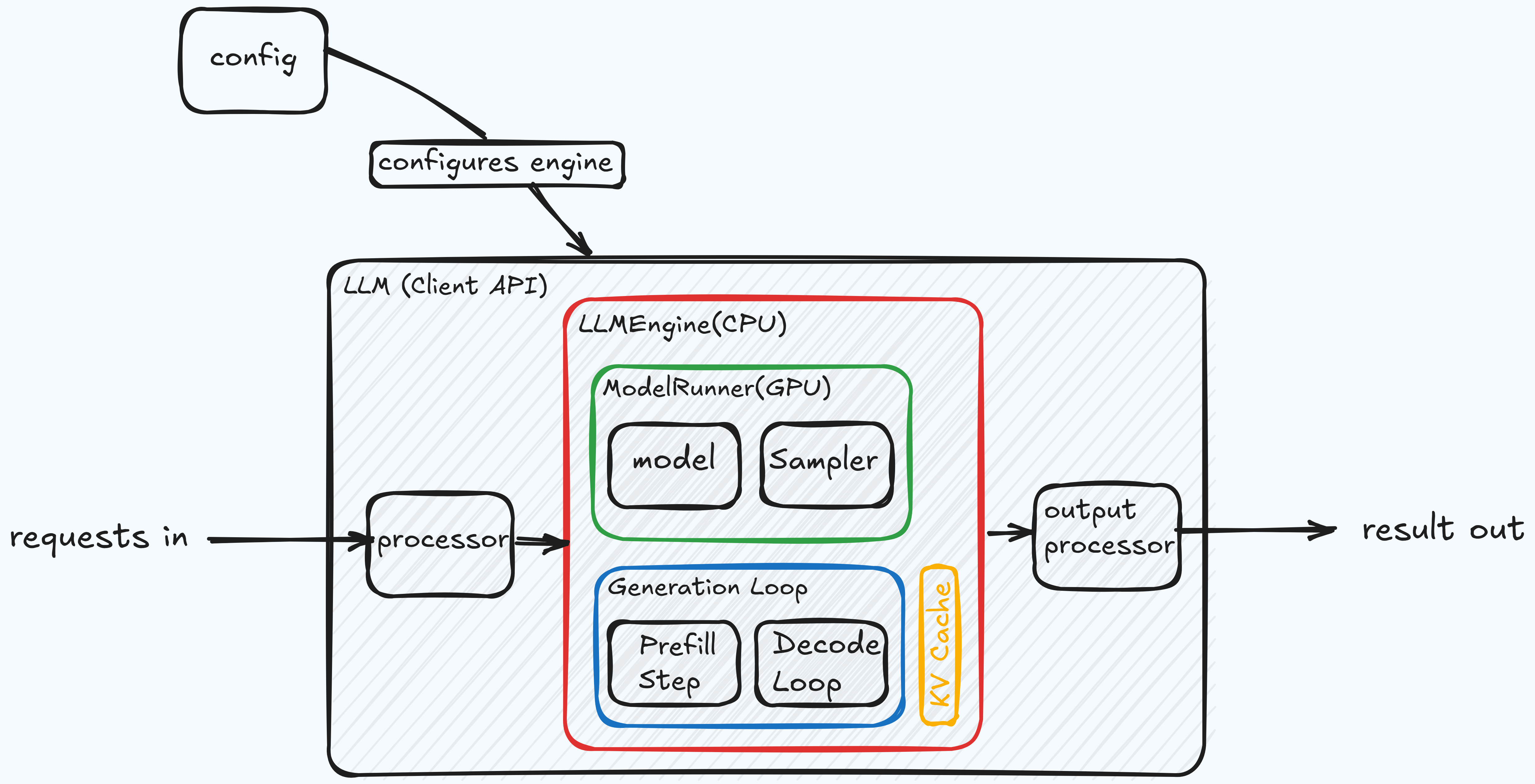
LLM: what you touch. You give it text, it gives text back. That’s it.
LLMEngine: the CPU orchestrator. It turns text into tokens, manages the KV cache, and drives the core loop: prefill, then decode token by token.
ModelRunner: the GPU executor. Owns the model and sampler, runs the forward pass, returns logits. All the heavy math lives here.
The Baseline
I started with the simplest possible engine that could generate text. No caching, no optimization, just a raw loop.
# Prefill: the full prompt in one shot
logits = self._prefill(input_ids)                                # entire [B, S] through the model
next_token = self._sample_token(logits, sampling_params)         # sample the last position

# Decode: one token at a time
for _ in range(1, sampling_params.max_tokens):
    input_ids = torch.cat((input_ids, next_token.unsqueeze(1)), dim=1)  # grow the sequence
    logits = self._decode_step(input_ids)                               # re-runs the WHOLE sequence again
    next_token = self._sample_token(logits, sampling_params)
Inference happens in two phases. First is the prefill. The full prompt goes through the model in one shot, and we sample the first token from the logits of the last position.
Then we move to the second phase: the decode loop, where the tokens are generated one by one. But look closely at how we are doing it right now. We take the entire sequence, append the newly generated token, and run that entire growing sequence through the model again just to get one more token.
Let’s see how this engine actually performs.
Benchmark
The setup: 128-token prompts, generating 256 tokens, batch sizes from 1 to 64.
Qwen3-0.6B | 596M params | torch.bfloat16 | cuda
  28L / 16H / 128D | loaded in 7.6s | 1.13 GB VRAM

Benchmark
Prompt length: 128 | Max tokens: 256

Batch | Time (s) | TTFT (s) | TPOT (s) | VRAM (GB) |    TPS
------------------------------------------------------------
    1 |    7.031 |    0.032 |    0.027 |     1.153 |   36.4
    4 |   10.123 |    0.033 |    0.040 |     1.199 |  101.2
    8 |   21.092 |    0.041 |    0.083 |     1.259 |   97.1
   16 |   50.554 |    0.079 |    0.198 |     1.379 |   81.0
   32 |  124.495 |    0.195 |    0.487 |     1.621 |   65.8
   64 |  275.020 |    0.497 |    1.077 |     2.104 |   59.6
Let’s see what happens as the batch size goes up.
Batch 1 to 4: 36 tok/s at batch 1, 101 tok/s at batch 4. We added 4x the work, but the time only went up a little (7.0s → 10.1s). This means we are memory-bound. The GPU loads 1.1 GB of weights just to do a tiny bit of math. The compute cores finish their work instantly and then just sit there waiting. At batch 4, we load the exact same weights, but we use them on 4 sequences instead of 1. It is the same trip to memory, but we get 4x the tokens. We get this extra speed for free because the cores were just sitting idle anyway.
After batch 4: The free speed stops. Batch 8 stays around 97 TPS. By batch 64, throughput drops to 59 TPS and takes over 4.5 minutes. This happens because 64 sequences give the Tensor Cores enough math to keep them fully busy. The bottleneck completely flips. We are no longer waiting on memory. The memory is feeding weights just fine, but now the compute cores are working at maximum capacity. This means we are compute-bound.
The VRAM: 1.15 GB at batch 1, only 2.10 GB at batch 64: less than 2x memory for 64x the sequences. The weights dominate, and activations are tiny next to them. Memory is not our problem. The problem is pure waste: we recompute the full attention for every token, at every layer, every step.
This is the baseline. Slow, doing far too much work per token.
The code is on the baseline branch.
KV Cache
The baseline re-runs the whole sequence through the entire model on every decode step, just to get one new token. Those tokens never change. All of that recomputation is wasted work.
The Idea
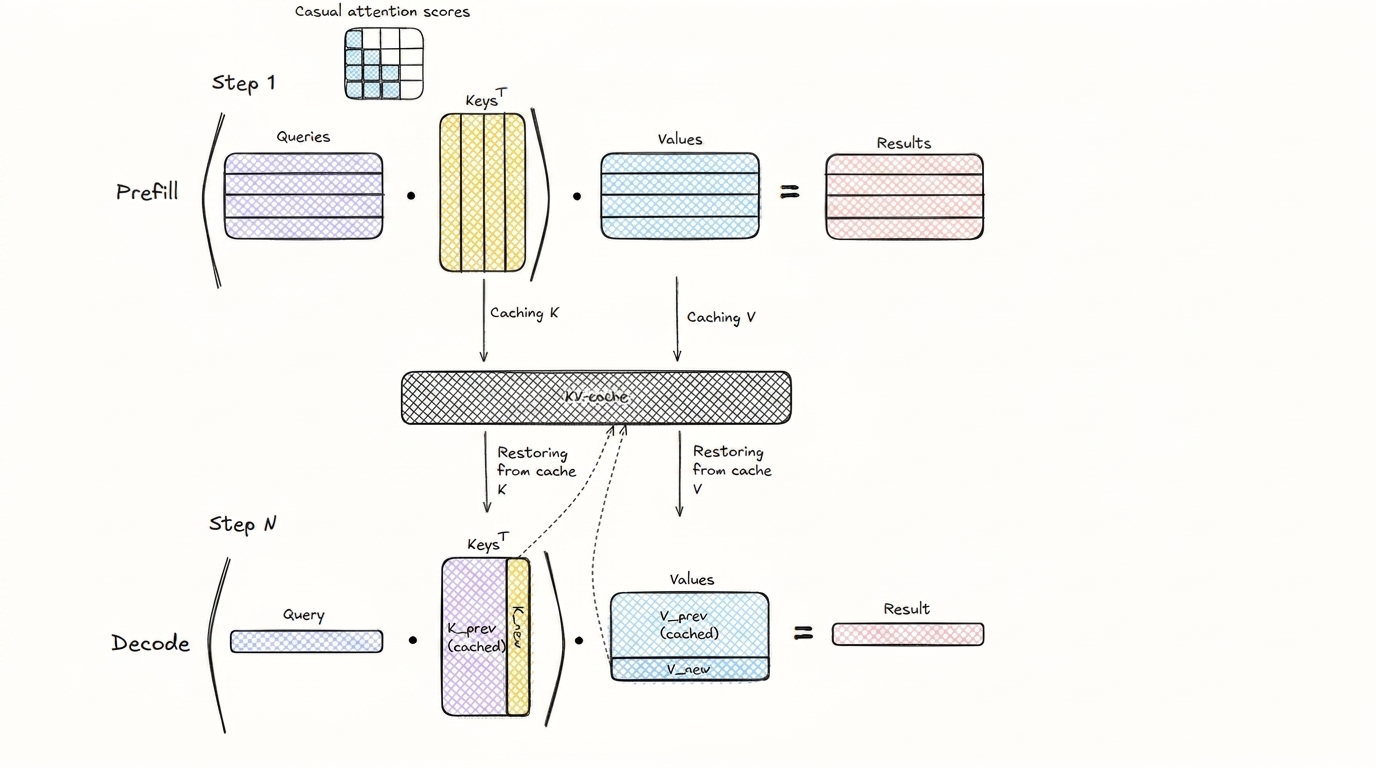
Look at what happens inside attention. Every token is projected into three vectors: Q (query), K (key), and V (value). Attention scores the queries against the keys, then uses those scores to weight the values. K and V of past tokens never change. Once a token is computed, its K and V vectors are permanently fixed and completely unaffected by future tokens. The only new thing a decode step brings is the Q, K, and V of that one new token. So compute them once and keep them. Store every token’s K and V the first time we see it, then read them back instead of recomputing.
The flow becomes:
Prefill: the full prompt goes through the model in one shot, like before. On the way, every layer writes its K and V into the cache.
Decode: only the new token goes through the model. It gets one Q, one K, one V. The cached K and V are restored, the new K and V are appended, and this single Q attends over the whole history. One token in, one token out. Nothing is computed twice.
Benchmark
Same setup: 128-token prompts, 256 generated tokens, batch sizes 1 to 256.
Qwen3-0.6B | 596M params | torch.bfloat16 | cuda
  28L / 16H / 128D | loaded in 10.9s | 1.13 GB VRAM

Warmup...

Benchmark
Prompt length: 128 | Max tokens: 256

Batch | Time (s) | TTFT (s) | TPOT (s) | VRAM (GB) |    TPS
------------------------------------------------------------
    1 |    9.318 |    0.045 |    0.036 |     1.184 |   27.5
    4 |    9.303 |    0.051 |    0.036 |     1.323 |  110.1
    8 |    9.241 |    0.044 |    0.036 |     1.505 |  221.6
   16 |    9.327 |    0.078 |    0.036 |     1.873 |  439.2
   32 |    9.591 |    0.194 |    0.037 |     2.609 |  854.2
   64 |    9.897 |    0.485 |    0.037 |     4.079 | 1655.5
  128 |   10.338 |    1.080 |    0.036 |     7.021 | 3169.8
  256 |   14.802 |    2.175 |    0.049 |    12.904 | 4427.4
Here is what changed compared to the baseline:
TPOT: In the baseline, the time to generate a token (TPOT) increased as batch size grew, taking over 1 second at batch 64. With the KV cache, TPOT stays at 36 milliseconds from batch 1 all the way to batch 128. The time barely increases as the batch size grows. it stays almost constant, with even batch 256 taking only 49ms.
Memory Bound: The time per token stays mostly stable between batch 1 and 128 because the generation step is memory-bound. Generating a single token requires very little math. The GPU finishes the calculations almost instantly, and spends most of its time waiting for data (like the weights for each layer, the KV cache, and activations) to arrive from VRAM. The GPU can load the extra data for up to 128 sequences with zero slowdown. Only at batch 256 does the amount of data finally push the time up to 49ms.
The VRAM Cost: This scaling requires more memory. We are trading VRAM for compute speed. At batch 1, the cache uses about 50 MB. At batch 256, storing the Keys and Values for all sequences uses nearly 12 GB of VRAM. We shifted the bottleneck from compute to memory.
By using VRAM to store past states, we remove redundant calculations, keep generation time constant, and increase throughput to over 4k tokens per second.
The code is on the kv-cache branch.